‘Never before in the history of the Federal Republic was rail transport so important as today’. Praising rail’s performance and achievements during the Covid-19 pandemic, Federal Minister for Transport & Digital Infrastructure Andreas Scheuer said ‘we have seen how important and reliable rail is, with robust passenger services and uninterrupted carriage of freight’.
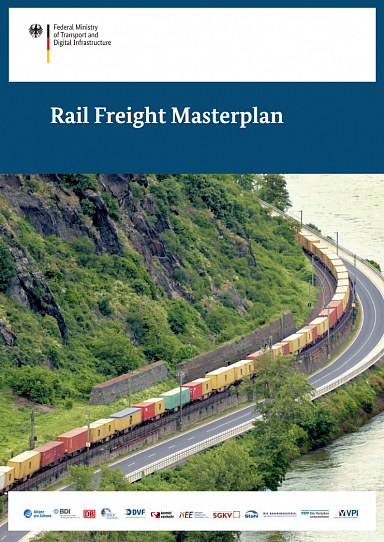
In his Foreword to the coalition government’s Master Plan for Rail, published at a ‘Rail Summit’ in Berlin on June 30, Scheuer went on to assert that ‘we will do all we can to make sure that the rail sector comes successfully through the pandemic situation and goes strengthened into the future ... We have a clear plan for the railway and for rail transport in Germany’.
On the face of it, the Master Plan represents an unprecedented government commitment to the rail mode. The planning process began in October 2018 when Scheuer unveiled details of the Zukunftsbündnis Schiene (Future Alliance Rail). This was a body set up to bring together organisations from politics, commerce and the rail sector with the aim of developing proposals and strategies that could be incorporated in the Master Plan.
Climate change strategy
The coalition government had identified rail as a central element in its strategy for meeting climate change goals, and as part of Zukunftsbündnis Schiene six taskforces were set up to formulate proposals under a 28-strong steering group led by Parliamentary State Secretary Enak Ferlemann. Each taskforce was assigned a specific area: the introduction of regular-interval services (Deutschlandtakt) to achieve better punctuality; expansion of capacity to ensure reliability; making rail competitive; noise and environmental issues; promotion of innovative technology; and staffing in the rail sector — forecasts suggest that up to 100 000 new personnel will be needed by DB AG alone over the coming years.
According to Scheuer, this was the first time that such an all-embracing platform had been set up to formulate railway strategy anywhere in Europe.
The steering group produced an interim report in May 2019. It followed this in October 2019 with a list of measures for immediate action, which the government then incorporated into its policy as commitments to the rail sector. Some of these are already in progress or have been agreed or implemented, while others remain aspirations and are not yet funded.
Ambitious objectives
The Master Plan has two primary objectives. First is to double the volume of passenger traffic by 2030 and second is to increase rail’s share of the freight market from the current 19% to at least 25% by the same date.
Switching freight from road to rail forms a ‘key element’ in the proposals for combatting climate change within the transport sector. Traffic, both freight and passenger, will only switch, the government believes, if network capacity is increased, with matching increases in rolling stock provision and staffing, accompanied by measures to make rail more attractive to its customers.
Taktfahrplan
The most ambitious proposal in the Master Plan is Deutschlandtakt, a national regular-interval timetable. This would see half-hourly inter-city services on the principal corridors connecting major cities, and hourly services on less important inter-city routes; frequent regional and local services would be tailored to offer good connections in and out of long-distance services across the network.
As happened with the introduction of the Swiss Taktfahrplan as long ago as May 1982 and its evolution into Switzerland’s Bahn 2000 programme, this represents a fundamental change of policy. Whereas previously the timetable was formulated to suit the infrastructure, the timetable requirement would now dictate what infrastructure needs to be made available.
Taking the Swiss Taktfahrplan as his model, Ferlemann saw the potential of Deutschlandtakt back in the 2000s. Acknowledging that the Swiss network was about the same size as that in the Land of Hessen, he recognised that the task of introducing connecting regular-interval services across the whole of Germany would be much more complex and demanding.
The slogan chosen to promote Deutschlandtakt is Öfter, Schneller, Überall. (more frequent, faster, everywhere.). Yet it is quite clear that achieving these objectives will be neither cheap nor quick. Adapting the network to handle many more services will require a huge programme of infrastructure upgrading and some new line construction, suggesting that many years will elapse before the full Deutschlandtakt concept becomes reality.
Ferlemann’s proposals were met initially with a lot of scepticism, especially from train operators — ‘it was as if I was a lone voice in the wilderness’, he recalls. But persistence eventually paid off, and over time Ferlemann succeeded in convincing much of Germany’s rail sector that the idea offered considerable merit. He now claims that ‘everyone supports the system’.