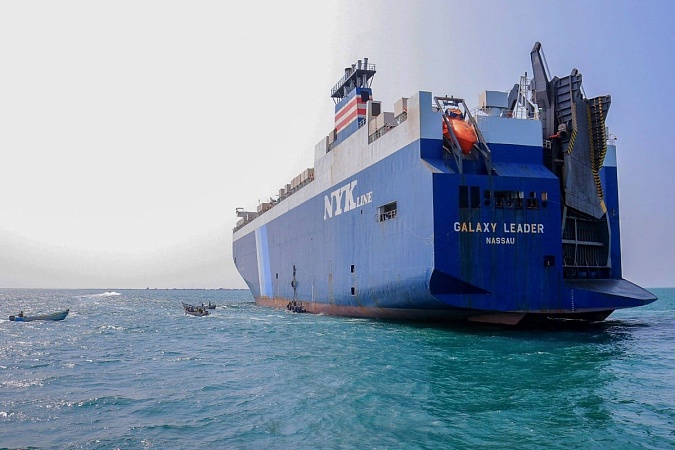
Houthi rebel groups in Yemen signalled in November they would halt attacks on commercial ships passing through the Red Sea if the Gaza ceasefire held, allowing a possible end to two years of costly detours for cargo shipping between Asia and Europe.
Dutch financial services group ING called the potential reopening of Red Sea shipping lanes a «key thing to watch for in container shipping» next year. And it would have particular significance for China: the world’s biggest merchandise exporter.
However, it may not be possible for companies to simply snap back to the status quo in 2023, before the attacks started. Here are three potential scenarios:
1. The Red Sea is safe and ships dive back in
Red Sea traffic could return to normal from next year, saving fuel, time and greenhouse gas emissions on Asia-Europe routes compared with detouring around Africa’s Cape of Good Hope.
«It’s not a matter of ‘if’, but ‘when’» this happens, ING said in a research note on Monday.
Red Sea passages cut down voyages between Asia and Europe by more than 3,000 nautical miles and 10 days compared with the Cape of Good Hope route, ING estimated.
They are also significantly cheaper. Sending ships all the way around Africa costs companies an extra US$30 to US$50 per 20-foot equivalent unit of cargo, said Surinder Brrar, a professor at the Hong Kong Polytechnic University’s Department of Logistics and Maritime Studies.
An estimated US$120 billion of Chinese imports and US$160 billion of Chinese exports pass through the Bab al-Mandab Strait, a Red Sea gateway, every year, according to the ThinkChina online magazine.
2. A slow recovery, hobbled by caution and hidden costs
A «return to normality» will only happen after insurance companies give their shipping clients an all-clear to use the Red Sea again, Brrar forecast.
Insurers are «by nature very conservative and will take some time before reducing their premiums for the Red Sea transit», he said. After a wave of Somali pirate attacks in the Gulf of Aden and Indian Ocean declined in 2017, insurers took a «fairly long time» to reduce their premiums, he added.
The most recent suspected Houthi missile attack hit the Dutch-flagged cargo ship Minervagracht in the Gulf of Aden, east of the Red Sea, on September 29.
Bulk carriers and tankers are likely to return to the Red Sea earlier than container ships because the value of their cargoes is lower, according to Brrar.
Once one major shipping line decided to restart Red Sea transit, others would be motivated to follow, ING said. European firms AP Moller-Maersk and Hapag-Lloyd «no longer rule out returning to the Red Sea», while CMA CGM «expects to resume transits shortly», it added.
But a swing back to the Red Sea would initially cause disruption, ING cautioned.
«Vessels arriving earlier than expected could trigger port congestion, which may again clog container terminals and cause delays for ships and empty containers across supply chains,» it said, adding that freight rates could also rise.
3. Firms continue using Red Sea alternatives
Shippers may still choose to stay away from the Red Sea for the time being. It remains possible that the Houthi groups could resume their attacks, as their apparent pledge to stop is tied to the Gaza ceasefire that has already shown signs of breaking down, according to some analysts. Many international shipping firms are taking a «wait-and-see approach» by continuing to use the Cape of Good Hope route, according to Rajiv Biswas, CEO of the Singapore-based research firm Asia-Pacific Economics.
Maersk has announced that an east-west shipping network it shares with Hapag-Lloyd has no «specific timing» to return to the Red Sea, citing the safety of crew, vessels and cargo.
«International shipping lines continue to confront a toxic cocktail of geopolitical risks in the Red Sea amid a fragile Gaza ceasefire and uncertainty about the durability of the Houthi truce on attacks on shipping,» Biswas said.
Meanwhile, the need to divert around Africa was «greatly assisting» marine shippers such as Shanghai’s Cosco Shipping Lines and Hong Kong-based Orient Overseas Container Line «due to the increased demand caused by the additional time and distances required», Brrar said.
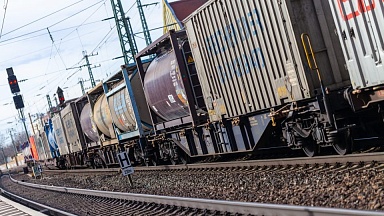
Chinese exporters, for their part, feel less pressure than before to switch back to Red Sea shipping routes, as freight rates on Cape of Good Hope services declined in 2024 due to new vessel deliveries to shipping companies among other factors. Exporters also have more options these days as alternative routes gain popularity. Asia-Europe rail freight services were seeing a «boost to demand» due to the Red Sea crisis, Biswas said.
And China’s relatively new «Arctic Express» sea route can get goods from Asia to Europe in half the time of a Red Sea passage, according to the National Association of Manufacturers, a US trade group.