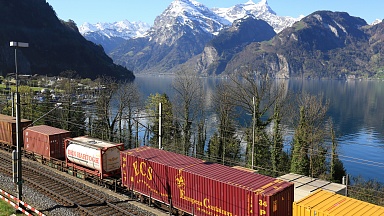
On January 1, the Guangdong-Hong Kong-Macao Greater Bay Area (GBA)’s first China-Europe freight train in 2026 departed from Zengcheng West Station at the Guangzhou Eastern Road-rail Intermodal Transport Hub under customs supervision. The train is scheduled to exit China via the Horgos border port and reach Malaszewicze, Poland, in around 14 days, marking the official launch of the China-Europe overland trade corridor for the new year, according to the General Administration of Customs (GAC).
The train carried 110 twenty-foot equivalent units (TEUs) with a total cargo value of about 20 million yuan ($2.8 million), mainly electronics, daily consumer goods and textile products manufactured in the GBA.
As a key hub linking the GBA with countries participating in the China-proposed Belt and Road Initiative (BRI), Zengcheng West Station has opened 14 outbound routes and eight return routes, reaching 34 cities in 17 countries across Europe, Central Asia and ASEAN, with its operating volume ranking the highest in Guangdong Province.
Beyond the GBA, freight trains also departed from multiple regions on New Year’s Day in 2026, reflecting broad-based and coordinated launches across the network. On January 1, a China-Europe freight train carrying goods such as ventilation systems departed from Wuhan Wujiashan Station, capital of Central China’s Hubei Province, for Copenhagen, Denmark, marking both the city’s first China-Europe service of the year and Hubei’s first direct rail link to a Nordic capital, according to China Railway Wuhan Group Co.
In Northwest China, Xi’an International Port Station also dispatched its first China-Europe freight train of the year, carrying 50 standard containers bound for Azerbaijan, highlighting the continued extension of the rail network toward Central Asia, according to China State Railway Group.
The strong start in early 2026 builds on solid momentum from the previous year. In 2025, China-Europe (Asia) freight trains made about 34,000 trips and carried 3.17 million TEUs, up 9.8 percent and 7.6 percent year on year respectively, with China-Europe services alone accounting for more than 20,000 trips. Meanwhile, freight volume on the New Western Land-Sea Corridor surged 47.5 percent to 1.42 million TEUs in 2025, China State Railway Group said in a statement it sent to the Global Times.
Trade flows by rail
Judging from the cargo mix, the first China-Europe freight trains of the new year were not limited to a single category but carried a broad range of goods, including home furnishings, electromechanical equipment, HVAC products (heating, ventilation, and air conditioning products) and daily consumer items. These higher value-added shipments, more closely aligned with end-market demand across Central Asia and Europe, suggest the rail service is moving beyond its early role as a supplementary route toward a more stable, regular trade channel.
Several exporters in Yiwu and Shenzhen said that amid volatile global shipping rates and growing uncertainty on some maritime routes, rail transport, valued for its stable transit times and predictability, is increasingly becoming a preferred option, particularly for orders with tight delivery deadlines.