When using, citing, or distributing the materials from this report, it is mandatory to reference the ERAI portal and include the webpage address https://index1520.com as the source of information.
China-Europe logistics market
Demand outlook
-
In February 2026, business activity in China grew at its strongest pace in five years. The composite PMI rose to 52,1 (+1,8 pp MoM), reaching its highest level since December 2020 [RatingDog / S&P Global]. The key driver was a powerful increase in output and demand. New export orders showed their strongest growth since September 2020. Amid strengthening market demand and the launch of new production lines, business expectations surged to an 11-month high. The increase in business activity and optimistic producer expectations indicate sustained high demand for export shipments from China.
-
Demand for Asia-Europe sea freight is recovering after the holidays in China, but growth rates are currently modest. Production activity in Asia is gradually increasing, while economic growth in the Eurozone remains subdued — persistent inflation and weak consumer confidence are restraining import demand.
-
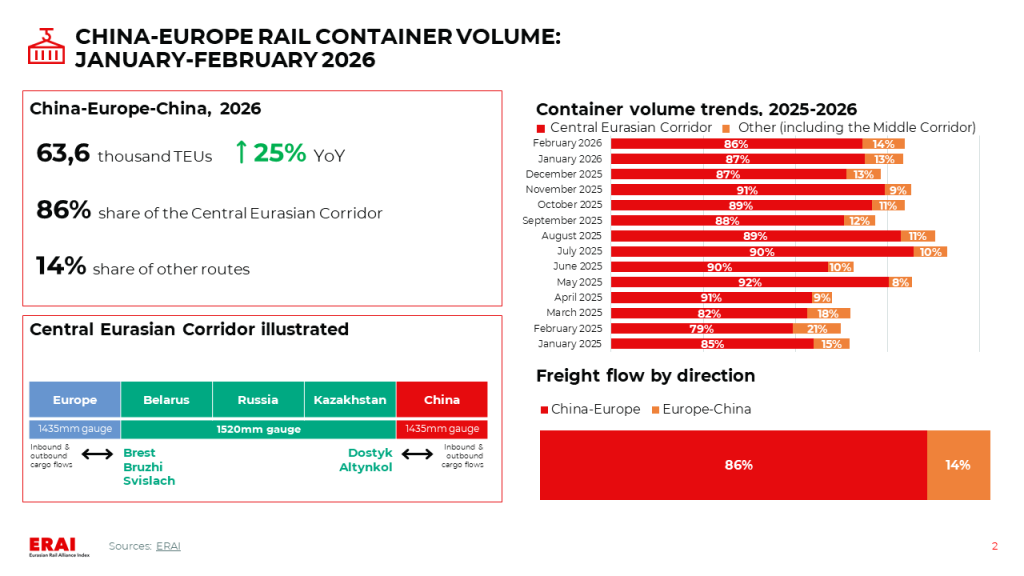
In January-February, the volume of China-Europe-China rail container transportation increased by 25% YoYwith volume on the Central Eurasian Corridor growing by 31% over the same period. In February, total shipment volume across all routes increased by 28% YoY, also rising by 1% MoM.
-
Against the backdrop of volatility in the maritime and air freight markets, some freight forwarders are noting a shift in demand towards rail. However, major players are more cautious in their assessment of the situation.
Freight rate trends
-
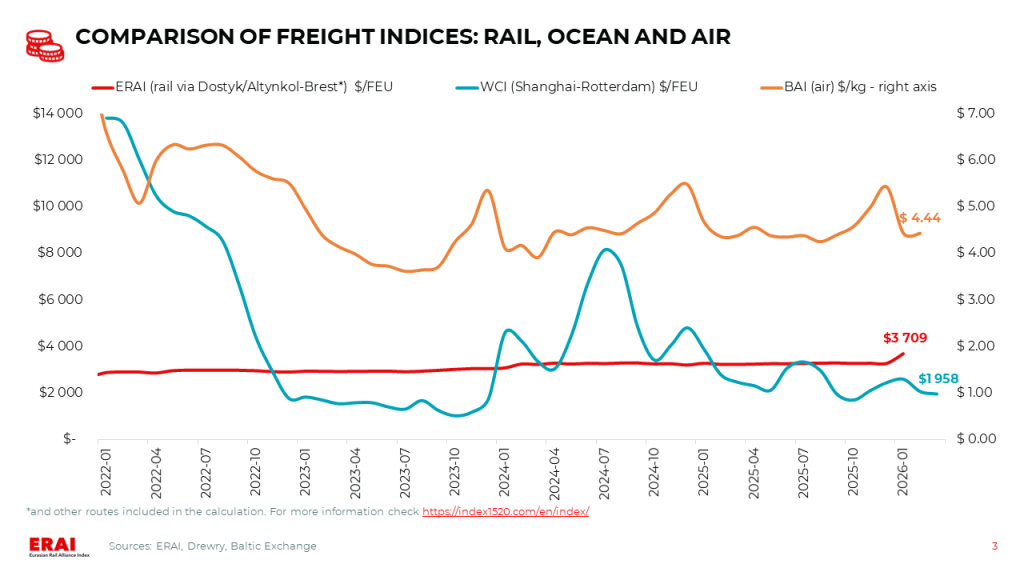
The Shanghai-Rotterdam WCI, as of 05.03.2026, fell to $2 052/FEU (-5% MoM, -22% YoY) [Drewry].
UPDATE: As of the evening of March 12, 2026, the latest WCI Shanghai-Rotterdam reading has risen by 19% WoW — up to $2 443/FEU.
The Shanghai-Genoa WCI rose to $2 844/FEU. For the second half of March, carriers have planned rate increases due to a sharp rise in fuel costs and insurance premiums. According to GeekYum, quotations average in the range of $3 000/FEU to $4 000/FEU depending on the carrier. -
Futures traders expect Asia-Northern Europe ocean freight rates to remain in the $2 000-3 000/FEU corridor for the remainder of 2026.
Other trends
-
On March 10, 2026, Brent crude oil prices fell sharply below $90/barrel after rising to nearly $120 in the previous session amid signals of a possible end to the conflict with Iran. However, the bunker market continues to price in the previous surge. From February 27 to March 10, the price of very low sulfur fuel oil (VLSFO) in Singapore doubled, breaking through the $1 000/ton level [Ship & Bunker]. Major container lines are introducing emergency fuel surcharges starting March 16 [ICIS].
-
Kuehne + Nagel warns of congestion at Asian airports due to the closure of airspace over the Middle East [JOC]. Approximately 18% of global air cargo capacity has effectively been removed from the market following airport closures in the region. Against this backdrop, bottlenecks are expected in China and Southeast Asia for shipments to the US and Europe. The situation resembles the pandemic-era supply-demand imbalance and is expected to bring even more pronounced rate increases for air carriers than in the maritime segment.
-
Amid air freight disruptions, shippers are beginning to consider road transport as an alternative for urgent cargo [Logistics Manager]. According to Girteka, road delivery on the China — Europe route via Central Asia currently takes approximately 14-18 days. Industry experts note that infrastructure development and simplified border procedures in Central Asia, primarily in Kazakhstan, are making this corridor increasingly competitive for high-value cargo.
Ocean freight: high volatility in the market will most likely translate into rate increses for shippers and a further deterioration of service
Current Situation and Near-Term Outlook: Market volatility is rising amid the conflict in the Middle East.
-
Demand for Asia-Europe sea freight is recovering after the holidays in China, but growth rates remain modest. Production activity in Asia is gradually increasing, while economic growth in the Eurozone remains subdued — persistent inflation and weak consumer confidence are restraining import demand.
-
Delays persist at key ports, and the operational situation will most likely continue to worsen. As of 07.03.2026, delays amounted to 432 thousand TEU in Northern Europe (33% MoM) and 887 thousand TEU in North Asia (-26% MoM) [Linerlytica]. Additional risks are emerging for Southeast Asian hubs due to service adjustments in connections with the Persian Gulf. Congestion is leading to missed connections and a collapse in reliability: in February, container service punctuality plummeted to 18% (eeSea; Xeneta).
-
The Shanghai-Rotterdam WCI, as of 05.03.2026, fell to $2 052/FEU (-5% MoM, -22% YoY) [Drewry]. The Shanghai-Genoa WCI rose to $2 844/FEU. For the second half of March, carriers have planned rate increases due to a sharp rise in fuel costs and insurance premiums. According to GeekYum, quotations for China-Northern Europe average in the range of $3 000/FEU to $4 000/FEU depending on the carrier.
-
From February 27 to March 10, the price of very low sulfur fuel oil (VLSFO) in Singapore doubled, breaking through the $1 000/ton level [Ship & Bunker].
Medium- and Long-Term Outlook: The escalation of tensions in the Middle East has further reduced the likelihood of shipping resuming through the Suez Canal [Flexport]. Insurance companies have begun withdrawing war risk cover for the Persian Gulf and Gulf of Oman, making the operation of commercial vessels practically impossible without specialized insurance premiums at inflated rates. Even after the conflict ends, it could take up to six months to assess the situation.
China-EAEU logistics market
Import and export trends
-
The Middle East conflict has impacted global supplies of oil, gas, aluminum, and fertilizers, temporarily enhancing the appeal of Russian raw materials on world markets. Simultaneously, the halt of shipping in the Strait of Hormuz has paralyzed container transportation in the region, causing explosive growth in freight rates and insurance costs [Kommersant]. For Russia, the escalation is a double-edged sword: in the short term, it promises windfall revenues from rising energy prices, but the decisive factor is the conflict’s duration. A protracted war risks collapsing global demand for raw materials and triggering a recession, ultimately nullifying current gains [Finam]. Chaos on sea routes creates a window of opportunity for alternative routes: land corridors and the Northern Sea Route are becoming more competitive against the backdrop of unpredictability in traditional maritime shipping.
-
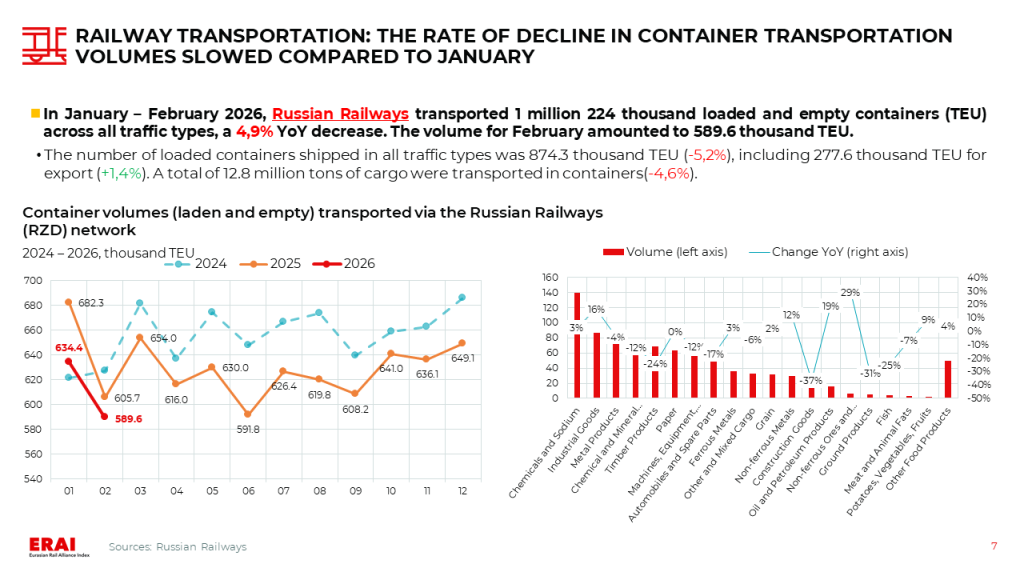
In January — February 2026, Russian Railways transported 1 million 224 thousand loaded and empty containers (TEU) across all traffic types, a 4,9% YoY decrease. The volume for February amounted to 589.6 thousand TEU.
-
The PBC Container Index at the end of February 2026 rose to $6 778/FEU (+2% MoM). he increase was primarily driven by rising rates for direct container trains from China to Russia. Tariffs increased by an average of $300/FEU (+6% MoM) due to a shortage of space on rail services, as well as mass delays in train departures from Chinese stations. At the same time, ocean freight rates from China to Russia’s eastern, western, and southern ports showed weak dynamics in February.
-
Current import rates within the 1520 mm gauge rail network: $3 300 — $3 350/FEU for Altynkol/Dostyk-Moscow; $3 700/FEU for Zamyn- Uud-Moscow; $3 450 — $3 500/FEU for Zabaikalsk-Moscow. Some logistics platforms are recording increased demand for spot shipments and are raising rates for such shipments by ~500$. The current situation with container trains from China to Russia is characterized by growing delays, especially on eastern routes. The worst problems are recorded for shipments via Manzhouli and Erenhot, where delays reach 2–4 weeks (e.g., Zhengzhou, Changsha, Shijiazhuang). Routes via Kazakhstan (Alashankou/Khorgos) remain more stable with delays within 1–7 days, but the situation is also deteriorating there.
Other trends
-
According to an updated forecast from IERT, container transportation volumes on the Russian Railways network will reach 8 million TEU by 2027 (+5,3% compared to 2025) and will grow 1,5 times to 10–12 million TEU by 2035. Constraining factors remain volatility in maritime rates, dumping by Chinese road carriers, and sanctions pressure, while growth drivers will be tariff discounts on the International North—South Transport Corridor routes, development of terminal infrastructure, and attracting transit from maritime transport to rail [InfraNews].
-
InfraNews has published the latest edition of the Railway Market Confidence Index, which remains in negative territory for the fourth consecutive month. The main reason was massive snowfall, which, combined with RZD regulatory restrictions, led to disruptions in operator activities. In the container segment, the situation was complicated by the introduction of new train formation rules: dispatching trains from certain stations in China via Kazakhstan now requires a length of at least 71 conventional cars, which contradicts the technical capabilities of the neighboring side and increases downtime at the border. Market participants note that the current situation is characterized by a lack of short-term prospects for improvement, and overcoming the crisis will require significant investments amid uncertain long-term demand.