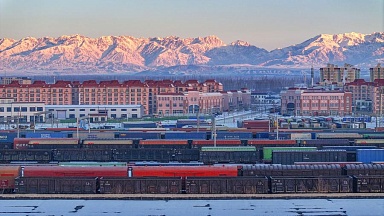
The China-Europe railway network has evolved in the past decade from a nascent logistical experiment into a growing commercial alternative to maritime and air freight. In the wake of the US-Israel war on Iran, it might now be assuming an unanticipated role as a key security provider for transcontinental supply chains.
What began as sporadic trial runs has matured into a sprawling web of rail connections that currently links 235 cities across 26 European countries with more than 120 Chinese cities.
This growth is being propelled by economic calculus as well as strategic infrastructure investments and geopolitical recalibrations. Notably, the rise of the trans-Caspian route, also known as the Middle Corridor, has added resilience and diversification to the network, reducing dependence on Russia and opening new commercial and political possibilities for both China and Europe.
The Covid-19 pandemic acted as a catalyst as air freight capacity collapsed and sea lanes faced port congestion and container shortages. The railway demonstrated some degree of reliability, carrying personal protective equipment and vaccines at critical moments, which enhanced its reputation among logistics firms.
Between 2020 and 2023, the number of China-Europe goods train trips doubled, surpassing 17,000 annually. This commercial uptake was supported by bilateral customs agreements, standardised container tracking and coordinated border procedures.
A key geographic and strategic evolution has been the increasing prominence of the trans-Caspian corridor. Following Russia’s invasion of Ukraine in 2022, sanctions and geopolitical risks prompted Chinese and European operators to accelerate investment in the Middle Corridor, which traverses Kazakhstan, the Caspian Sea, Azerbaijan, Georgia and Turkey before entering Eastern Europe.
Though historically slower because of multiple border crossings and ferry connections across the Caspian, the route has seen dramatic upgrades. These include modernised ports in Aktau (Kazakhstan) and Baku (Azerbaijan) and the expansion of the Baku-Tbilisi-Kars railway’s capacity.
The railway has reduced China’s vulnerability to naval chokepoints such as the Malacca Strait and fosters economic interdependence with Central Asia and Europe. Politically, the railway offers Beijing a tangible tool for influence: countries along the route benefit from Chinese infrastructure loans and increased trade volumes, creating a web of mutual interest.
This has not been a one-way street favouring China’s interests. While many European nations are wary of being too dependent on China, some have embraced the railway for its economic utility. For instance, Germany has seen the former steel hub of Duisburg transform into Europe’s largest rail hub for Chinese freight.
This symbiosis, however, coexists with growing European scrutiny over China’s Belt and Road Initiative and its transparency and environmental standards, as well as China’s state-driven industrial policies. The railway thus becomes a double-edged sword: it deepens commercial ties but also amplifies European anxieties about asymmetric dependency.
Geoeconomically, the railway is recalibrating transcontinental logistics and regional development. For Central Asian and Caucasus countries such as Kazakhstan, Azerbaijan and Georgia, the trans-Caspian route has turned them from peripheral post-Soviet states into critical transit hubs. Kazakhstan’s dry port of Khorgos on the Chinese border handled more than 372,000 20-foot equivalent units last year, while Georgia’s Poti and Batumi terminals on the Black Sea saw robust growth in 2025.
For Europe, the railway offers a mechanism for de-risking: companies can maintain some access to Chinese markets without fully relying on sea freight or Russian overland transit. As the traditional entry point of the Northern Corridor, Poland has seen its logistics sector boom, though it now competes with Romania and Hungary, which are developing connections to the Middle Corridor via the Black Sea.
Nevertheless, challenges remain. The China-Europe railway still carries only a fraction of the tonnage moved by sea, roughly 1 per cent by volume. The trans-Caspian part of the route still suffers from capacity constraints at Caspian ferry crossings and differences in rail gauges.
In terms of China-Europe ties, the railway has fostered a more pragmatic, operational partnership that sometimes operates below the political radar. Even during diplomatic tensions over human rights, technology competition and trade imbalances, the railway working groups between China’s National Development and Reform Commission and Europe’s rail freight associations have continued to meet and expand timetables for freight services. This creates a stabilising influence: when political rhetoric heats up, logistics cooperation can provide a channel for constructive engagement.
However, the railway also amplifies structural competition. As Europe accelerates its green transition, the railway’s carbon footprint is under scrutiny. China’s push for a trans-Caspian digital railway using Chinese 5G standards also raises questions about technological sovereignty. Meanwhile, European rail manufacturers such as Siemens and Alstom see the influx of the China Railway Rolling Stock Corporation’s goods into Europe as a competitive threat.
As geopolitical turbulence increasingly weighs on maritime chokepoints — from the closure of the Strait of Hormuz by both the United States and Iran to Houthi attacks in the Red Sea — the China-Europe railway emerges not as a mere alternative but as a strategic imperative. Unlike sea lanes, which can be weaponised through naval blockades, insurance premium increases or sea mines, rail corridors traverse sovereign territories whose economic interests align with keeping goods moving.
For Europe, diversifying supply chains onto this rail network is a form of resilience insurance. For China, it is a demonstration that land-based connectivity offers immunity from naval disruption. In an era of recurring chokepoint crises, the steel rails across Eurasia provide a vital, if partial, hedge against the weaponisation of the world’s seas.