- Container lines are rushing to slap war-risk surcharges on Middle East and Red Sea cargo as the conflict escalates
- Hormuz transits are largely paused, with dozens of containerships waiting and booking visibility near zero
- Cosco has also suspended boxship transits through the strait on safety grounds, despite speculation that China-linked vessels may be exempt
- War-risk insurance is being withdrawn/repriced sharply, reinforcing the commercial and operational shutdown
CONTAINER shipping lines are rushing to impose war risk surcharges on Middle East cargo as a «knee-jerk response» to the rapidly escalating conflict in the region, even as many have suspended vessel transits through the Strait of Hormuz.
«The knee-jerk response is to announce the surcharges first and then decide if they want to take bookings. Right now, there is no visibility when the bookings can restart,» said Linerlytica co-founder Hua Joo Tan.
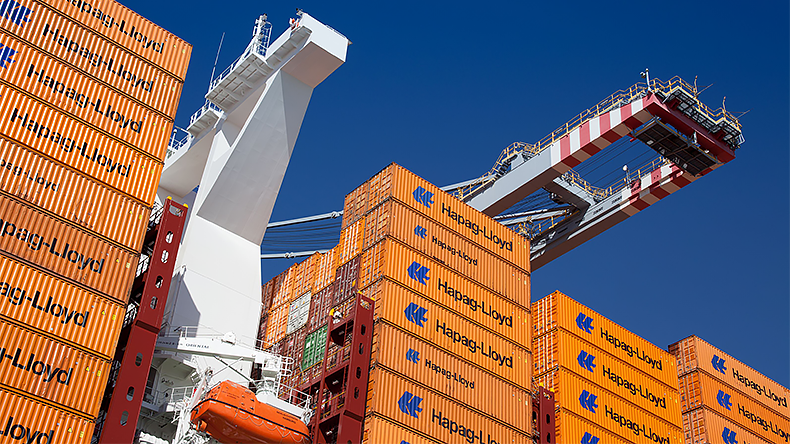
Hapag-Lloyd has introduced a war risk surcharge of $1,500 per teu for standard containers and $3,500 per box for reefers and special equipment, effective March 2, for cargo moving to and from the Upper Gulf, Middle East Gulf and Arabian Gulf.
CMA CGM announced an emergency conflict surcharge of $2,000/$3,000 per teu/feu for dry containers and $4,000 for reefers or special equipment, also effective March 2. The surcharge applies to cargo moving to or from Iraq, Bahrain, Kuwait, Yemen, Qatar, Oman, the United Arab Emirates, Saudi Arabia, Jordan, Egypt/Ain Sokhna, Djibouti, Sudan and Eritrea.
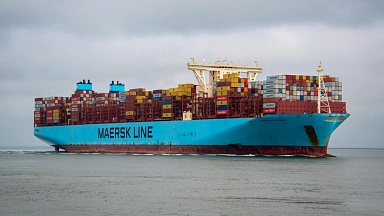
Maersk will levy an emergency contingency surcharge on its Middle East Gulf and Indian subcontinent to North Europe and Mediterranean services, effective March 15.
These surcharges come as the world’s largest container lines have suspended services to the Middle East Gulf region amid Iran’s de facto blockade of the critical waterway. Some have also rolled back recently restored services transiting the Suez Canal as the widening crisis raises fresh concerns over the safety of the Red Sea route.
According to Lloyd’s List Intelligence data, approximately 60 containerships are currently waiting on either side of the Musandam Peninsula at the southern entrance to the Strait of Hormuz, ranging in size from a few hundred teu to 19,000 teu. No vessels have been tracked actively transiting the strait, although the possibility of ships passing with AIS transponders switched off cannot be ruled out.
One notable follower is Cosco Shipping, which said its containerships would halt transits through the strait on safety grounds, despite speculation that Chinese-linked vessels might be granted exemptions from Tehran.
The decision is not entirely unexpected, however. When Houthi militants began attacking commercial vessels in the Red Sea, the Chinese carrier similarly avoided the area — even though Chinese ships were widely seen to be immune from such attacks.
The status of the state-owned giant’s other shipping segments, including its tanker, gas carrier and dry bulk fleets, remains unclear. Cosco’s dry bulk vessels have been regular travellers through the Red Sea and the Bab el Mandeb Strait.
Vessel-tracking data also shows the Cosco-operated very large crude carrier Xin Long Yang (IMO: 9761463) successfully transited the Strait of Hormuz into the Gulf of Oman on February 28, the same day the first tanker, US-sanctioned Skylight (IMO: 9330020), was reportedly struck near the strait.
Since then, three more tankers — Hercules Star (IMO: 9916135), MKD Vyom (IMO: 9284386) and Ocean Electra (IMO: 9402782) — were hit by projectiles near the strait, according to Lloyd’s List Intelligence’s vessel casualty reports.
The largest of these, the 74,032 dwt MKD Vyom, was reported by Bloomberg to be chartered to Saudi Aramco. The increasing attacks have heightened shipowner concerns over navigational safety in the region.
Soaring insurance
Beyond the immediate physical risks, soaring war risk insurance costs are emerging as a powerful commercial deterrent. Steamship Mutual, one of the member clubs of the International Group of P&I Clubs, issued a circular on March 1 notifying members that its reinsurers had cancelled existing war risk coverage for the Middle East Gulf, effective 72 hours after midnight GMT on March 1.
The club said it could offer a buyback facility with limits up to $200m, but the repricing of war risk premiums in the current threat environment is expected to be dramatically higher than pre-crisis levels.
Not all Chinese carriers have followed suit on suspending services, however.
China United Lines, a smaller privately owned carrier that has built up exposure in the Red Sea and Middle East trades, told customers it would continue accepting bookings for the Red Sea and eastern Mediterranean, though it flagged that its Middle East Gulf services rely on slot purchases from other operators and would be subject to their decisions.
The carrier, nevertheless, also announced steep war risk surcharges of $2,000-$3,000 per teu for Red Sea cargo, with fak base rates rising to $5,000-$7,000 per teu.
by Cichen Shen
Photo source: Hasenpusch Photo