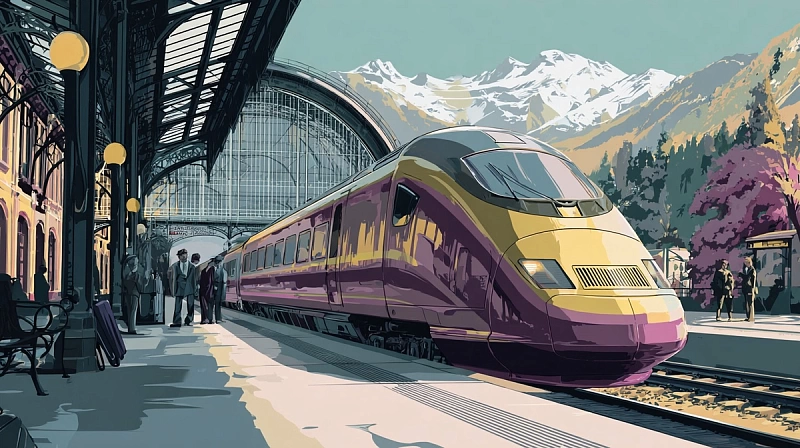
At the beginning of November, EU Transport Commissioner Apostolos Tzitzikostas proudly unveiled the action plan for a high-speed rail network connecting Europe’s major cities. Just days earlier, Chinese trains had been approved for passenger rail transport in the EU for the first time. These two developments, arriving in such quick succession, expose a glaring contradiction at the heart of European policy: ambitious climate goals paired with a stubborn reluctance to protect and promote the industries that could deliver them.
The EU’s transport targets are nothing if not bold—doubling high-speed passenger rail by 2030 and tripling it by 2050, with the explicit aim of making flying redundant for medium and short distances. In economic terms, this agenda presents extraordinary opportunities: the expansion of the high-speed network alone will require investments of €550 billion by 2050, while around €46 billion must be spent annually across the bloc on new rolling stock. The comprehensive introduction of the European Rail Traffic Management System (ERTMS) will cost a further €190 billion by mid-century, unlocking significant capacity gains through digitalisation.
Unlike other areas of decarbonisation, the EU is exceptionally well positioned to lead this transition itself. The European rail industry is a high-tech sector with a commanding global position: more than 650,000 employees generate €45.8 billion in turnover, with Germany alone accounting for some 50,000 workers and €12 billion in revenue. Crucially, skilled workers from the crisis-ridden automotive sector are increasingly finding employment in rail manufacturing, thanks to transferable qualifications. The pieces are in place. What remains missing is the strategic vision to assemble them.
The market-liberal paradigm has run out of track
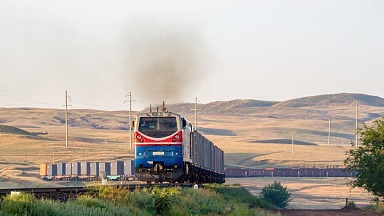
The announcement by Austrian railway company Westbahn that it would become one of the first EU operators to deploy Chinese trains sparked immediate criticism from trade unions and the rail industry association alike. Their objections cut to the heart of a long-simmering debate: does Europe want to repeat the mistakes it made with photovoltaics, batteries and electric vehicles—ceding market after market to competitors who plan strategically—or will it finally harness its technological leadership to forge a new economic and industrial policy?
The Council of Transport Ministers opened a window of opportunity in early December, convening a debate on an EU economic strategy for the rail sector. This was a welcome, if overdue, step. For decades, the EU has eschewed active industrial planning, preferring to set political objectives while enforcing strict competition and state-aid rules and leaving the rest to market forces. That paradigm is now visibly failing: in key technologies of the future, Europe has fallen behind economic blocs such as China, which pursue strategic industrial planning with unapologetic vigour.
Rail offers unusually favourable conditions for a different approach. Beyond the industry’s technological edge, the sector remains one of the few in which public funds and public ownership still predominate. This means governments can pursue effective demand-side industrial policy through long-term investment programmes, strategic procurement criteria and clear policy guidelines—levers that are simply unavailable in most other industries.
Equally important is how that demand is shaped. Public procurement can embed binding social, environmental and local-content criteria that promote innovation while guaranteeing fair working conditions. The rail industry can also act as a catalyst for other European technologies of the future, from green steel and bionics to sensor technology and micro- and nanoelectronics. The recent German Steel Summit, at which Deutsche Bahn committed to purchasing green European steel, illustrates how rail can serve as a lead market that pulls other sectors towards decarbonisation. Hardly any other industry is so well suited to anchor a new socio-ecological economic policy—one that accelerates structural change, creates quality jobs and enables the phase-out of fossil fuels alongside reductions in energy and resource consumption.
Three pillars for a rail-industry strategy
Realising this potential demands a decisive break with the old market-liberal approach. Despite the enthusiasm surrounding November’s high-speed rail action plan, the document remains fundamentally shaped by familiar thinking: set ambitious goals and trust the market to deliver. That plan must now be supplemented by an EU economic strategy for rail built on three pillars.
The first is financing. The investment figures speak for themselves. In the next multiannual financial framework (2028–2034), the Connecting Europe Facility transport budget must be increased to €100 billion. This is essential not only because of the yawning investment gap but because the expiry of NextGenerationEU funding from 2026 will eliminate roughly €50 billion in rail subsidies that were available in the current framework.
The second pillar is industrial policy. Social, environmental and local-content criteria should be applied systematically to public procurement across the EU and made a prerequisite for private entities providing public services. The bloc should also seize the opportunity to use rail as a lever for other climate-critical industries. A green-steel quota for the sector—perhaps as a condition for accessing Connecting Europe Facility transport funds—could create the lead markets European steelmakers need to justify long-term investments in climate-friendly production processes such as electric-arc furnaces.
The third pillar concerns technological sovereignty and security. The approval of Chinese trains in Europe raises urgent questions about the integrity of critical systems. Rail vehicles used in European passenger, freight and military transport must meet the highest safety requirements and be immune to remote interference from third countries, as Josef Doppelbauer, head of the European Union Agency for Railways until last year, recently warned. This will require adjustments to the Technical Specifications for Interoperability (TSI) and mandatory, comprehensive reviews of digital autonomy and cybersecurity. Where necessary, public participation in companies must be considered to retain control over key operations. In critical infrastructure and the technologies that underpin it, Europe cannot afford dangerous dependencies.
Europe stands at a crossroads. It can continue to leave the mobility transition to the market—and risk forfeiting value creation, jobs and technological leadership once again—or it can seize this historic moment to make rail the centrepiece of a new, socio-ecological economic policy. The technologies exist, the economic potential is immense, and the case for action is beyond dispute. A European economic strategy for the rail industry would be far more than an industry-specific programme; it would be a first, tangible step towards an economic policy that does not merely proclaim climate targets but achieves them through planning and strategic action.