The TEN-T 2030 deadline for the core network «will not be met» as the «megaprojects» are facing «increased costs and further delays in implementation». «Europe can not afford more decade-long delays for transport projects. These infrastructures are essential for mobility, for thr single market and for the competitivveness,» said Annemie Turtelboom, the Member of European Court of Auditors who led ECA special report «EU transport infrastructure. Further delays and some cost increases, but a reinforced governance framework is in place for the future», released on January 19, 2026.
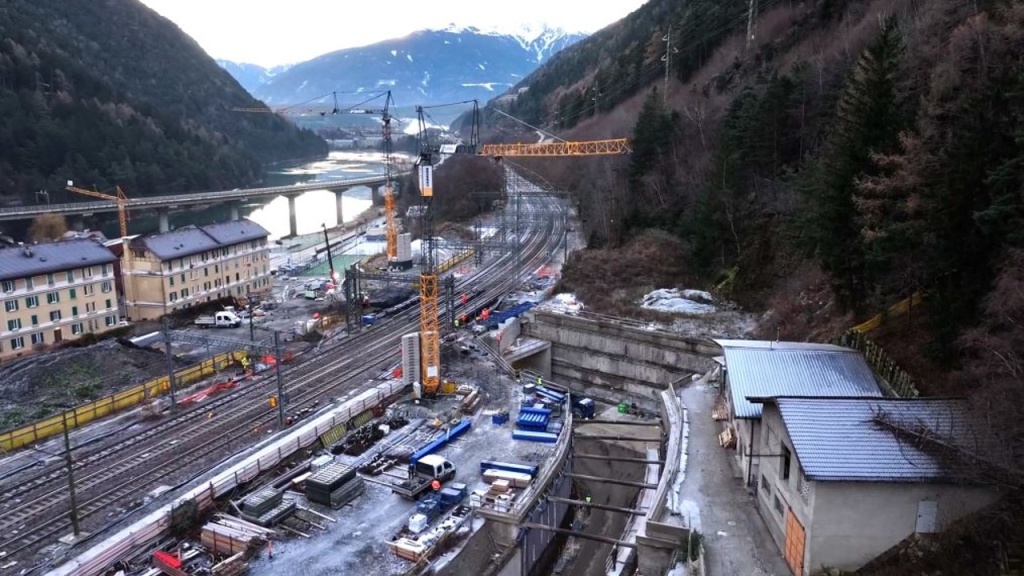
Works on Brenner Base Tunnel project. Photo: BBT SE
While the ECA’s 2020 report already concluded that meeting the TEN-T 2030 deadline was unlikely, the latest assessment delivers a more definitive verdict: the deadline will not be achieved.
The new report reviews progress on eight core cross-border transport projects, six of which are rail projects, and finds that the situation in 2025 has deteriorated compared with 2020. Although the pandemic and Russia’s war of aggression against Ukraine have played a role, auditors point to additional pressures stemming from new regulatory requirements and unforeseen technical challenges.
Cost escalation remains a major concern. In 2020, the ECA reported an average real cost increase of 47% across the eight megaprojects compared with initial estimates. The latest findings show that this figure has now risen to 82%, almost double the previous level.
Delays continue to escalate
Delays have worsened further, with five transport megaprojects experiencing additional setbacks compared both to their original schedules and to the findings of the 2020 report. According to the 2025 report by the EU auditors, these five projects are now facing an average delay of 17 years, up from 11 years in the previous assessment. Excepting the rail projects, the report includes the Canal Seine Nord Europe inland waterway project in France and the A1 motorway project in Romania. Given that these projects represent critical transport links, this development makes it clear that the TEN-T 2030 deadline for completing the EU core network will undoubtedly be missed.
Delays affecting each rail transport project
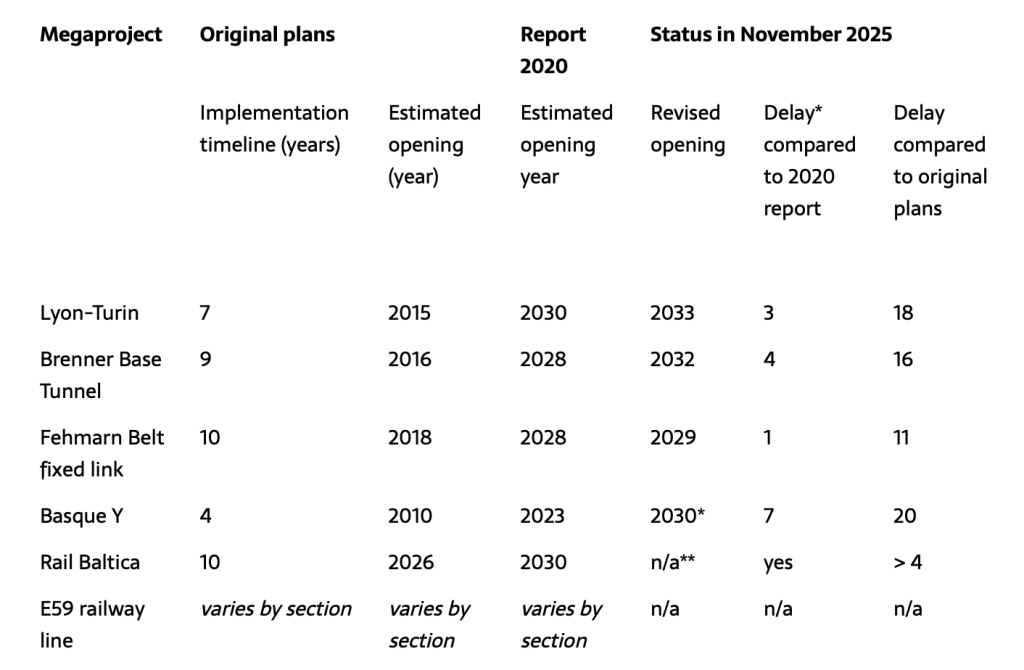
Source: ECA
*While the Commission has indicated to ECA 2030 as likely completion date, information from the project promoters points to a 2035 completion date
**No estimated opening year is available for the full project. The first phase of the project is estimated to open in 2030.
The Basque Y railway project is experiencing its longest delay to date, now reaching 20 years. Initially scheduled to enter service by 2010, and later revised in 2020 with an operational target of 2023, the project is now expected to be completed no earlier than 2030, although project promoters acknowledge that 2035 is a more realistic timeframe.
The Lyon—Turin rail link is currently forecast to open in 2033, significantly later than the 2015 date set in the original plans and the 2030 target outlined in the 2020 schedule. Similarly, the Brenner Base Tunnel is now expected to become operational from 2032 at the earliest, rather than in 2016 or 2028, as previously anticipated.
In October, Germany and Denmark announced that the commissioning of the Fehmarn Belt project will be postponed, compared with the originally planned opening in 2029.
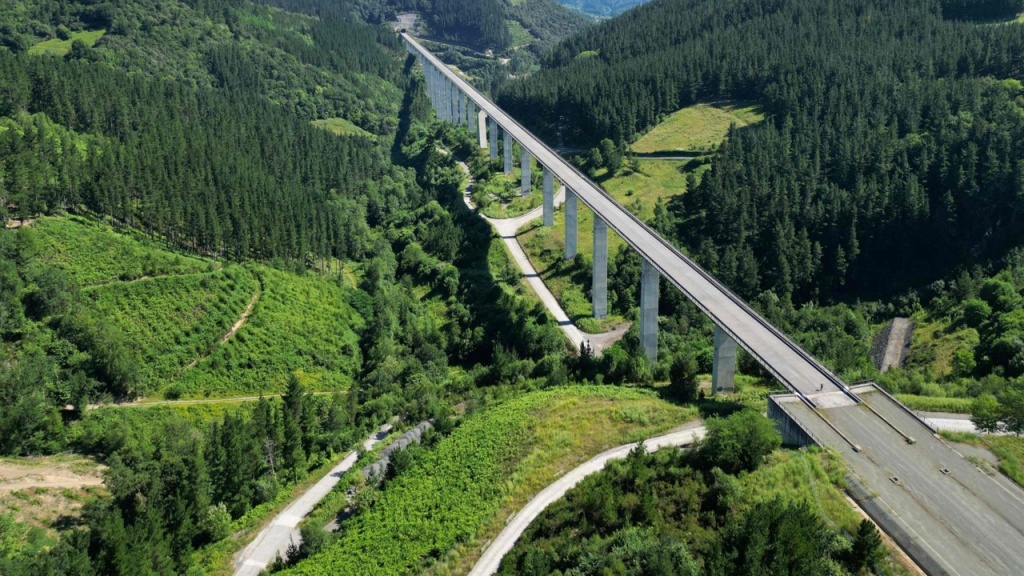
Viaduct construction part of Basque Y project. Photo: Adif AV
For Rail Baltica, delays previously identified are likely to increase further. The most recent implementation plan, published in November 2025, indicates that only the first phase of the project is expected to be completed by 2030. At present, it is not possible to quantify the additional delay, as no implementation timeline has been published for the second phase.
A comparable lack of clarity surrounds the E59 railway line (Poznań—Szczecin). At the time of this update, no information was available on when the full infrastructure will be completed. As a TEN-T project crossing Poland, the E59 line forms part of a key international rail corridor linking Scandinavia with Central Europe, supporting cross-border rail transport and broader European connectivity objectives.
Overall, these delays are closely linked to shortcomings in planning and implementation, which in turn have led to significant cost increases across major European rail infrastructure projects.
Soaring costs undermine the TEN-T 2030 deadline
Since the publication of the 2020 report, overall cost estimates for major TEN-T projects have risen by 24%, while compared with the original plans, total costs have increased by 82%. One particularly striking example is the Canal Seine—Nord Europe inland waterway project, where costs had surged by 225% as of November 2025. Among rail projects, cost escalation has been especially pronounced. Rail Baltica has recorded the largest increase, with costs rising by 291%, bringing the estimated total to nearly EUR 18.2 billion. The Lyon—Turin rail link has also seen a substantial rise of 127%, with projected costs now standing at EUR 11.8 billion.
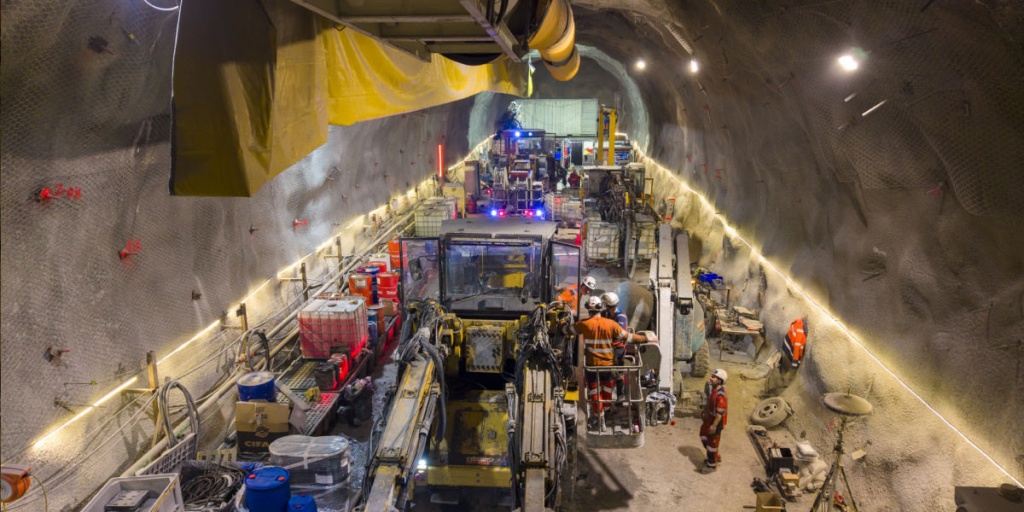
Works on Lyon-Turin rail link. Photo: TELT
By contrast, the E59 railway line in Poland is the only rail project to report a cost reduction, with estimates 18% lower than originally planned.
The scale of cost inflation is particularly evident in the case of Rail Baltica. Initially estimated at EUR 5.8 billion in 2017, the project promoter RB Rail announced in 2024 that the total projected cost for the full project had increased to EUR 23.8 billion, underscoring the growing financial pressure facing flagship TEN-T projects.
Cost developments for each rail project (million euros)
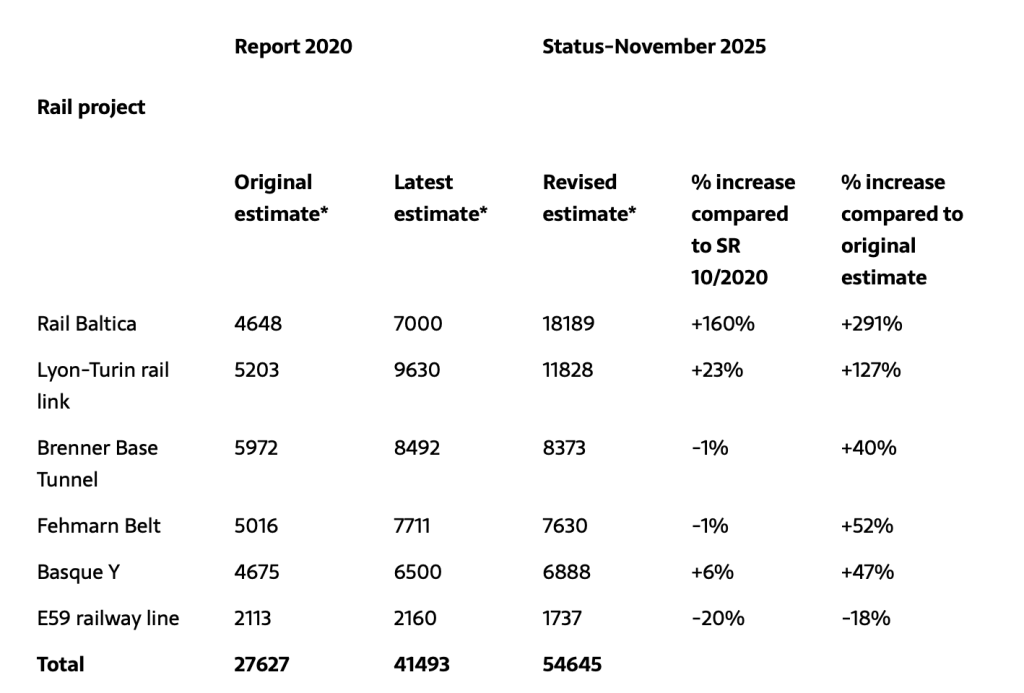
Source: ECA. *In 2019 values
Limited legal framework
One of the key challenges has been the lack of robust legal instruments to address delays in the development of the EU’s core transport network. Until recently, the European Commission had limited capacity to intervene when projects fell behind schedule or encountered implementation problems.
This situation has evolved with the adoption of the 2024 TEN-T Regulation, which significantly strengthens the Commission’s role. The revised framework introduces clearer obligations for Member States and provides the Commission with enhanced oversight powers to monitor progress and support the timely delivery of the network. As a result, the EU now has a stronger legal basis to guide and supervise the completion of TEN-T infrastructure across all Member States.
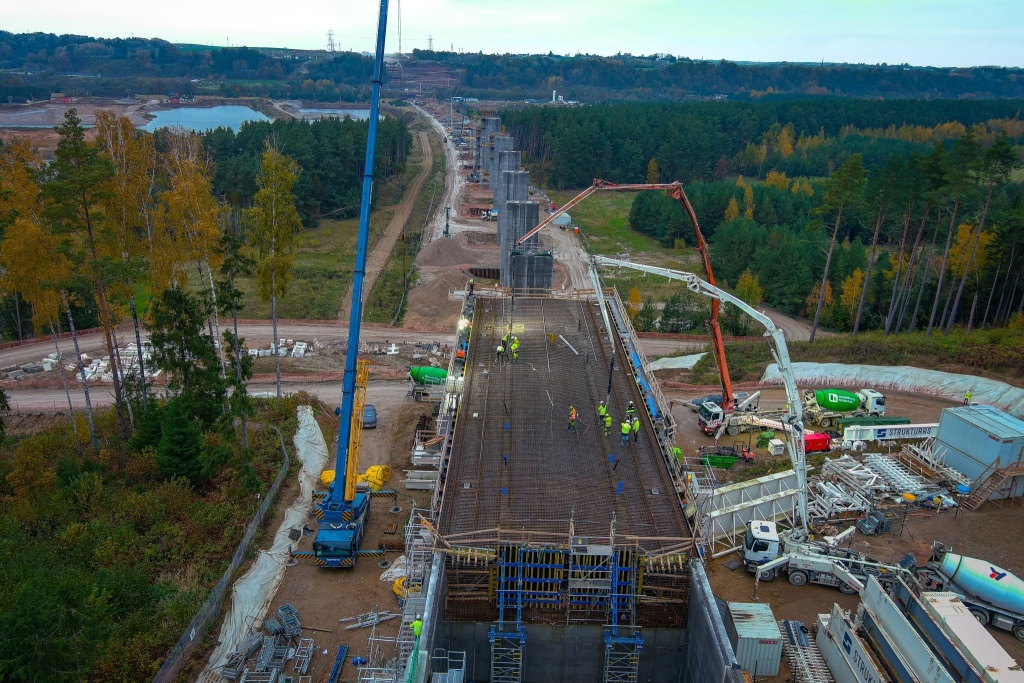
Works on Rail Baltica. Photo: RB Rail
«The effectiveness of the new tools will depend largely on how actively they are applied, and how fully Member States comply. Moreover, most of the new legal instruments are primarily designed for projects in the planning phase, rather than those already under construction. In other words, the toolbox has improved, but the projects we analysed are already too advanced for these tools to reverse the existing risks,» Annemie Turtelboom said.
The 2024 TEN-T Regulation also reinforces the EU’s role in strategic transport planning by introducing a new legal requirement for Member States to align their national transport plans with EU priorities. Rather than being developed independently, national strategies are now expected to reflect the broader European framework.
When preparing these plans, national authorities must take into account the work programmes of the European Coordinators, as well as any implementing acts adopted at EU level. Once completed, the plans must be submitted to the European Commission, which will assess them and issue a formal opinion. Although this assessment is not legally binding, it is intended to promote closer alignment and stronger coordination between national policies and European transport objectives.