When using, citing, or distributing the materials from this report, it is mandatory to reference the ERAI portal and include the webpage address https://index1520.com as the source of information.
China-Europe logistics market
Demand outlook
- In November 2025, China’s economy showed widespread slowdown: industrial production growth was only 4.8% (a 15-month low), while retail sales rose by just 1.3% — the worst performance since the end of the coronavirus pandemic. The weakness is attributed to the exhaustion of state consumer subsidies, a protracted real estate market crisis undermining household confidence, and declining investment. Authorities relied on exports to support growth, but this strategy faces increasing pushback: trade partners, including France and Mexico, are threatening new tariffs due to China’s record $1 trillion surplus. International organizations are calling for structural reforms, with growth expected to remain weak in 2026 [Reuters].
- According to the latest S&P Global PMI data released on December 16, Germany’s manufacturing sector in December 2025 showed its sharpest contraction in ten months: the index fell to 47.7 points from 48.2 in November, missing forecasts of 48.5. This means that after nine months of growth, production volume has re-entered a contraction zone. The decline in German industry exerted significant pressure on the entire Eurozone: the region’s Composite Output Index dropped to 51.9 points, and the Eurozone Manufacturing PMI fell to 49.2 points, reaching an eight-month low.
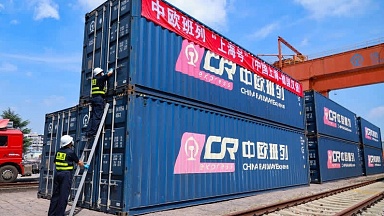
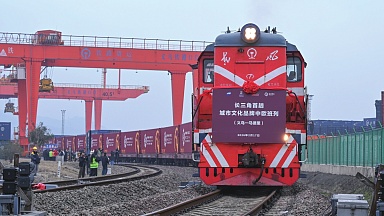
- In January-November, the volume of China-Europe-China rail container transportation decreased by 19% YoY. In November, the total shipment volume across all routes fell by 1,3% YoY but increased by 2% MoM. Volume growth in November compared to October, as well as year-on-year, was recorded in the Central Eurasian Corridor. Conversely, a decline in flows was noted on the Middle Corridor, partly due to seasonal delays in the Caspian Sea.
- Demand for Asia-Europe sea freight has increased significantly in recent weeks. According to Flexport, this may be linked to the recovery of European demand for consumer goods and auto components, as well as increased shipments ahead of new EU environmental regulations taking effect in 2026. An additional factor is the traditional seasonal increase in shipments before the Chinese New Year.

Freight rate trends
- The Shanghai-Rotterdam WCI increased by 5% last week to $2 361/FEU (16% MoM, −51% YoY) [Drewry]. The Shanghai-Genoa WCI increased by 13% for the week to $3 004/FEU. According to Drewry, rate increases may continue in the near term due to a seasonal demand surge. GeekYum data shows the average spot rate from major carriers for the second half of December is $2 500-2 900/FEU. January rates start from $3 000/FEU, but only some lines have provided quotes.
- Participants in Asia-Northern Europe futures trading expect a decline after the first quarter, with rates in the $1 500-2 000/FEU corridor for most of 2026.

Other trends
- The CHNL portal has published the results of the Northern Sea Route’s performance during the 2025 navigation season, demonstrating stable transit growth. During the summer-autumn season, 103 voyages were completed, a 6.2% increase over 2024, with total cargo turnover reaching 3.2 million tons. The main growth was in the bulker (23 voyages) and container ship (15 voyages) segments, with container shipping volume setting a record of 400 thousand tons. Overall, the corridor maintains its role as a seasonal alternative for cargo flows, primarily between Russia and China.
Ocean freight: short-term market uptick amid persistent medium- and long-term risks
Current Situation and Near-Term Outlook: The recovery trend continues.
- Demand for Asia-Europe sea freight has increased significantly in recent weeks. According to Flexport this may be linked to the recovery of European demand for consumer goods and auto components, as well as increased shipments ahead of new EU environmental regulations taking effect in 2026. An additional factor is the traditional seasonal increase in shipments before the Chinese New Year.
- Significant disruptions persist in Asian and European ports. The main reasons are a surge in cargo flow, adverse weather conditions, and structural issues in container handling and evacuation from European terminals. Due to the disruptions, carriers are adjusting schedules. For instance, a voyage on the China-Europe route was recently cancelled, and, according to market expectations, further cancellations will follow in the near term. As of 30.11.2025, port delays amounted to: 325 thousand TEU in Northern Europe (-26% MoM) and 1.4 million TEU in North Asia (+13% MoM) [Linerlytica].
- The Shanghai-Rotterdam WCI increased by 5% last week to $2 361/FEU (16% MoM, −51% YoY) [Drewry]. The Shanghai-Genoa WCI increased by 13% for the week to $3 004/FEU. According to Drewry, rate increases may continue in the near term due to a seasonal demand surge. GeekYum data shows the average spot rate from major carriers for the second half of December is $2 500-2 900/FEU. January rates start from $3 000/FEU, but only some lines have provided quotes.
- Medium- and Long-Term Outlook: The overall trend continues to point towards a growing supply-demand imbalance and intensifying competition.
- Carriers are considering a gradual resumption of Suez Canal transits in 2026 [JOC, JOC]. Currently, only CMA CGM has scheduled voyages for late December and January. Other players are considering the period after the Chinese New Year.