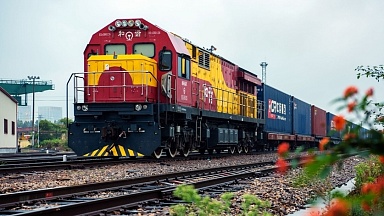
The Horgos Customs said Wednesday that the port has witnessed sustained growth in freight train operations, with a daily average of over 27 trains since the start of 2025.
The trains are increasingly used to transport goods from China’s manufacturing hubs like the Yangtze River Delta and Pearl River Delta to markets in Central Asia and Europe, the customs added.
The China-Europe (Central Asia) rail service offers distinct advantages, including faster transit than sea freight, lower costs than air transport and stable scheduling, earning strong recognition from clients, said Li Qing, business manager of a local international freight forwarding company.
Li said his company has handled over 2,000 trains this year, up 20 percent annually, with cargo volume rising 23 percent to 5 million tonnes.
Efficiency at the port has improved significantly, with import cargo clearance shortened from two to three days to within 16 hours, and export processing reduced from six hours to just one hour.
In total, over 50,000 China-Europe (Central Asia) freight trains have passed through Horgos Port, operating on 90 routes and reaching 46 cities and regions across 18 countries.