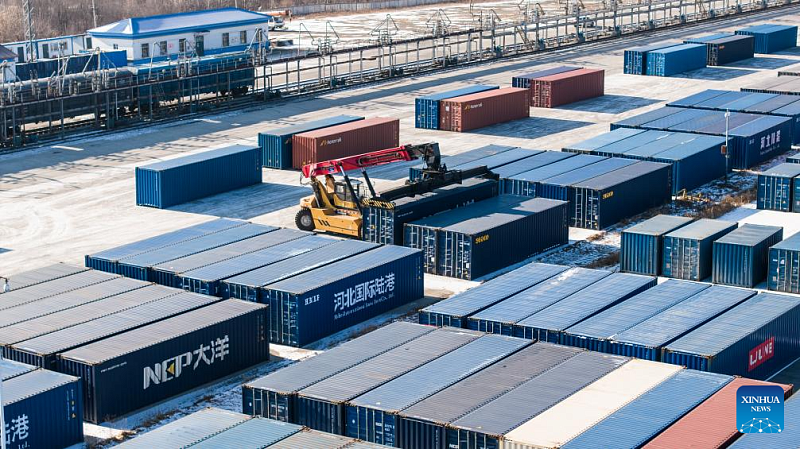
As a China-Europe freight train composed of 60 carriages and loaded with home appliances and digital products departed from the Manzhouli railway port in north China’s Inner Mongolia Autonomous Region, the «eastern corridor» of the China-Europe freight train network this year has witnessed 5,166 trains operating on its railway lines.
The «eastern corridor» consists of three railway ports including Manzhouli, Suifenhe and Tongjiang. Currently, the categories of goods transported by the trains have increased to more than 1,000 types. The number of operating routes has expanded to 27, linking over 60 Chinese cities with 14 European countries.
A drone photo taken on Dec. 9, 2025 shows a China-Europe freight train preparing to depart from the Tongjiang north railway station in Tongjiang, northeast China’s Heilongjiang Province.
As a China-Europe freight train composed of 60 carriages and loaded with home appliances and digital products departed from the Manzhouli railway port in north China’s Inner Mongolia Autonomous Region, the «eastern corridor» of the China-Europe freight train network this year has witnessed 5,166 trains operating on its railway lines.
The «eastern corridor» consists of three railway ports including Manzhouli, Suifenhe and Tongjiang. Currently, the categories of goods transported by the trains have increased to more than 1,000 types. The number of operating routes has expanded to 27, linking over 60 Chinese cities with 14 European countries.
A drone photo taken on Dec. 9, 2025 shows a China-Europe freight train departing from the transshipment yard of Tongjiang north railway station in Tongjiang, northeast China’s Heilongjiang Province.
As a China-Europe freight train composed of 60 carriages and loaded with home appliances and digital products departed from the Manzhouli railway port in north China’s Inner Mongolia Autonomous Region, the «eastern corridor» of the China-Europe freight train network this year has witnessed 5,166 trains operating on its railway lines.
The «eastern corridor» consists of three railway ports including Manzhouli, Suifenhe and Tongjiang. Currently, the categories of goods transported by the trains have increased to more than 1,000 types. The number of operating routes has expanded to 27, linking over 60 Chinese cities with 14 European countries.
A drone photo taken on Dec. 10, 2025 shows cranes working at Suifenhe railway station in Suifenhe, northeast China’s Heilongjiang Province.
As a China-Europe freight train composed of 60 carriages and loaded with home appliances and digital products departed from the Manzhouli railway port in north China’s Inner Mongolia Autonomous Region, the «eastern corridor» of the China-Europe freight train network this year has witnessed 5,166 trains operating on its railway lines.
The «eastern corridor» consists of three railway ports including Manzhouli, Suifenhe and Tongjiang. Currently, the categories of goods transported by the trains have increased to more than 1,000 types. The number of operating routes has expanded to 27, linking over 60 Chinese cities with 14 European countries.
A drone photo taken on Dec. 10, 2025 shows China-Europe freight trains preparing to depart from the Manzhouli railway station in Manzhouli, north China’s Inner Mongolia Autonomous Region.
As a China-Europe freight train composed of 60 carriages and loaded with home appliances and digital products departed from the Manzhouli railway port in north China’s Inner Mongolia Autonomous Region, the «eastern corridor» of the China-Europe freight train network this year has witnessed 5,166 trains operating on its railway lines.
The «eastern corridor» consists of three railway ports including Manzhouli, Suifenhe and Tongjiang. Currently, the categories of goods transported by the trains have increased to more than 1,000 types. The number of operating routes has expanded to 27, linking over 60 Chinese cities with 14 European countries. (Photo by Huang Xu/Xinhua)
A drone photo taken on Dec. 10, 2025 shows China-Europe freight trains preparing to depart from the Manzhouli railway station in Manzhouli, north China’s Inner Mongolia Autonomous Region.
As a China-Europe freight train composed of 60 carriages and loaded with home appliances and digital products departed from the Manzhouli railway port in north China’s Inner Mongolia Autonomous Region, the «eastern corridor» of the China-Europe freight train network this year has witnessed 5,166 trains operating on its railway lines.
The «eastern corridor» consists of three railway ports including Manzhouli, Suifenhe and Tongjiang. Currently, the categories of goods transported by the trains have increased to more than 1,000 types. The number of operating routes has expanded to 27, linking over 60 Chinese cities with 14 European countries.
A drone photo taken on Dec. 8, 2025 shows cranes working at the transshipment yard of Tongjiang north railway station in Tongjiang, northeast China’s Heilongjiang Province.
As a China-Europe freight train composed of 60 carriages and loaded with home appliances and digital products departed from the Manzhouli railway port in north China’s Inner Mongolia Autonomous Region, the «eastern corridor» of the China-Europe freight train network this year has witnessed 5,166 trains operating on its railway lines.
The «eastern corridor» consists of three railway ports including Manzhouli, Suifenhe and Tongjiang. Currently, the categories of goods transported by the trains have increased to more than 1,000 types. The number of operating routes has expanded to 27, linking over 60 Chinese cities with 14 European countries.
A drone photo taken on Dec. 10, 2025 shows China-Europe freight trains preparing to depart from the Manzhouli railway station in Manzhouli, north China’s Inner Mongolia Autonomous Region.
As a China-Europe freight train composed of 60 carriages and loaded with home appliances and digital products departed from the Manzhouli railway port in north China’s Inner Mongolia Autonomous Region, the «eastern corridor» of the China-Europe freight train network this year has witnessed 5,166 trains operating on its railway lines.
The «eastern corridor» consists of three railway ports including Manzhouli, Suifenhe and Tongjiang. Currently, the categories of goods transported by the trains have increased to more than 1,000 types. The number of operating routes has expanded to 27, linking over 60 Chinese cities with 14 European countries.
A drone photo taken on Dec. 3, 2025 shows a China-Europe freight train departing from the Manzhouli railway station for European countries in Manzhouli, north China’s Inner Mongolia Autonomous Region.
As a China-Europe freight train composed of 60 carriages and loaded with home appliances and digital products departed from the Manzhouli railway port in north China’s Inner Mongolia Autonomous Region, the «eastern corridor» of the China-Europe freight train network this year has witnessed 5,166 trains operating on its railway lines.
The «eastern corridor» consists of three railway ports including Manzhouli, Suifenhe and Tongjiang. Currently, the categories of goods transported by the trains have increased to more than 1,000 types. The number of operating routes has expanded to 27, linking over 60 Chinese cities with 14 European countries.