Eurasian logistics market update. January 2026, issue 23

29.01.2026

The last two weeks at a glance

When using, citing, or distributing the materials from this report, it is mandatory to reference the ERAI portal and include the webpage address https://index1520.com as the source of information.

China-Europe logistics market

Demand outlook

  • China’s economy grew by 5.0% YoY in 2025, reaching the government’s target benchmark [Reuters]. Growth was driven mainly by strong industrial output (5.9%) and exports (5.5%). Consumer demand showed more subdued dynamics (3.7%). An export-oriented growth model resulted in China posting a record trade surplus of $1.2 tn. A widening trade imbalance with the EU increases the likelihood of tighter protectionist measures by European regulators.
  • In January 2026, industrial activity in the euro area returned to modest growth. The HCOB Eurozone Manufacturing PMI Output index rose to 50.2 after a contraction in December, but the headline manufacturing PMI remained in contraction territory (49.4) [S&P Global]. Export orders declined again, albeit less sharply than in December. This points to continued weakness in external demand, including from Asia, and provides no indication of a near-term pickup in shipments from Europe to China.
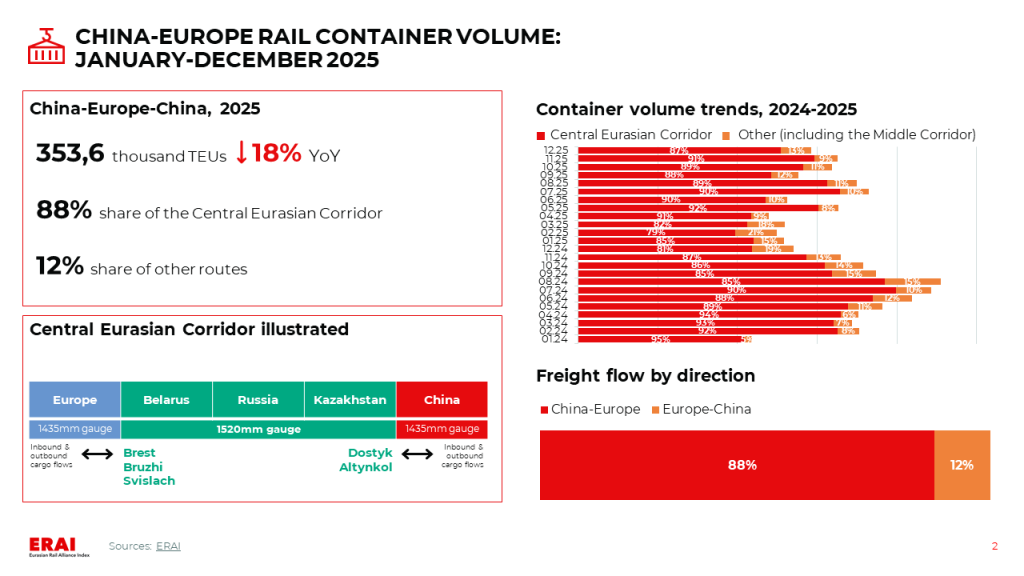
  • In January-December, China-Europe-China rail container volumes decreased by 18% YoY, while the volume on the Middle Corridor increased by 14% over the year. In December, the total volume across all routes grew by 8% YoY but declined by 10% MoM. Seasonal delays in the Caspian Sea limit the Middle Corridor’s potential for cargo flow growth.
  • Demand for Asia—Europe ocean shipping is starting to gradually soften. As Chinese New Year (17.02.2026–03.03.2026) approaches, the seasonal impulse is gradually fading. According to Flexport, most volumes have already been booked and the market is in a transition phase.

Freight rate trends

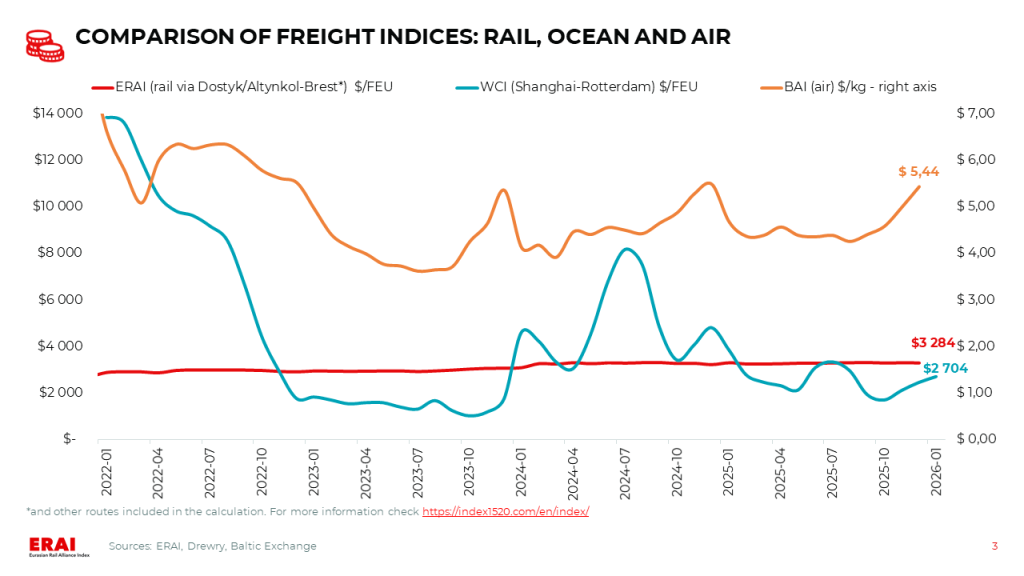
  • WCI Shanghai—Rotterdam, as of 22 Jan 2025, declined to $2 510/FEU (-1% MoM, −27% YoY) [Drewry]. WCI Shanghai—Genoa fell to $3 520/FEU. Market conditions did not allow carriers to execute an aggressive pre-holiday rate-hike scenario. For the remainder of January and February, the lines are focused on keeping rates at current levels. According to GeekYum, the average February spot rate is $2 200–2 600/FEU.
UPDATE: As of the evening of January 29, 2026, the latest WCI Shanghai-Rotterdam reading has declined by 5% WoW — down to $2 379/FEU.
  • Futures market participants expect a decline after 1Q2026 and rates in the $1 500–2 000 range for most of 2026. Xeneta forecasts rates falling back to 4Q2023 levels (<$1 500/FEU) even in the event of a partial recovery of transit via the Red Sea.
Slide0EN.png

Other trends

  • DHL Global Forwarding launched the multimodal Truckair service on the China—Europe route [JOC]. The route combines trucking from China to Tashkent (Uzbekistan) and an air leg to Istanbul (Turkey), followed by delivery across Europe. Transit time to Turkey is 9–11 days. The service has been operating for about 2 months and is positioned as a solution for transporting large consignments, with a focus on predictable transit times and lower costs versus direct air freight.
  • The Budapest—Belgrade railway line is preparing for launch [RailwayPRO]. Freight operations on the Hungarian section will open on 27 February 2026. The line will become a key link in the corridor for moving Chinese cargo from the Port of Piraeus, operated by COSCO, to Central Europe. Most of the rail line’s capacity has already been contracted.
Slide1EN.png

Ocean freight: the market is entering a phase of seasonal cooling, with a risk of further deterioration in the supply—demand balance

Current Situation and Near-Term Outlook: gradual fading of the peak season.

  • Demand for Asia—Europe ocean shipping is starting to gradually soften. As Chinese New Year (17.02.2026–03.03.2026) approaches, the seasonal impulse is gradually fading. According to Flexport, most volumes have already been booked and the market is in a transition phase.
  • To serve the Asia—Europe trade, carriers deployed a record level of capacity in January (~1.15 million TEU), but a decline is expected in February (to ~1.0 million TEU). Announced blank sailings for weeks 8–9 indicate carriers’ intention to actively manage supply after the holidays. Disruptions in North European ports and equipment shortages in China are constraining effective supply, allowing rates to remain elevated.
  • Significant delays persist in Asian and European ports. Key drivers include a surge in cargo flows, as well as adverse weather conditions and issues with handling and evacuating containers from European terminals (including via rail services). As of 25.01.2026, port delays amounted to 493 thousand TEU in Northern Europe (35% MoM) and 1.2 million TEU in North Asia (29% MoM) [Linerlytica].
  • WCI Shanghai—Rotterdam, as of 22 Jan 2025, declined to $2 510/FEU (-1% MoM, −27% YoY) [Drewry]. WCI Shanghai—Genoa fell to $3 520/FEU. Market conditions did not allow carriers to execute an aggressive pre-holiday rate-hike scenario. For the remainder of January and February, the lines are focused on keeping rates at current levels. According to GeekYum, the average February spot rate is $2 200–2 600/FEU.
  • CMA CGM again rerouted the FAL1, FAL3, and MEX services around the Cape of Good Hope, abandoning Suez Canal transit on the Europe-Asia leg [Xeneta]. The main reason is ongoing geopolitical uncertainty.
Medium- and Long-Term Outlook: the overall trend continues to point towards a growing supply-demand imbalance and intensifying competition

  • According to the forecasts, in 2026 spot rates may decline by up to 25% and contract rates by 10%.

Slide2EN.png

China-EAEU logistics market

Import and export trends

  • According to the Bank of Russia’s monitoring for January 2026, business activity of enterprises continued to grow, but the pace of growth slowed. The business climate indicator fell to 1.7 points from 2.6 points in December. Companies’ expectations regarding production volume and demand for their products over the next three months decreased, while their concerns about price growth reached their highest level since April 2022 (30.1 points). The decline in business and price expectations of enterprises signals a continued decrease in import shipments from China in the short term.
  • Russia-China trade turnover for 2025 decreased by 7% to $228 billion [InfraNews]. Imports from China fell by 10,4% to $103.3 billion, mainly due to a collapse in automobile supplies (-49%). Among key product groups, a decrease in purchases of industrial equipment (-3%) was noted, along with a sharp (almost 3-fold) increase in imports of parcels from online stores, which exceeded $4 billion. However, by December, imports had recovered to a record monthly level of over $11.7 billion. Exports to China for the year decreased by 4% to $125 billion but showed steady growth in the last four months, accelerating to +17% YoY in December.
  • Import rates in the China-Moscow multimodal corridor continue a gradual upward trend. The average transportation cost via Far Eastern ports has increased by $200/FEU over the past 2 weeks and now stands at ~$5 700/FEU (SOC). Rates for direct rail transportation have also risen, but the pace of growth is more moderate—an increase of $50 to ~$5 600/FEU (COC).
  • The PBC Container Index in mid-January 2026 rose to 6 549 $/FEU (+6% MoM). The main driver of growth was rates on routes via Russia’s southern ports (e.g., to Novorossiysk), where freight increased by 21% М/М. MoM due to seasonal pre-holiday demand. On other routes, including direct container trains from China to Russia, rate increases were more moderate — 5–8% MoM, attributed to Russian Railways tariff indexation and seasonal import growth.

Other trends

  • Global container shipping market indicators will grow by 1.5% in 2026, and the dynamics may slightly exceed the level of 2025. This was stated by Sergey Shishkarev, the founder of the Delo Group of Companies. In 2025, the Delo Group’s container shipping volume decreased by approximately 7%, while the total transportation volume reached 1.7 million TEU [Alta Soft]. In 2026, Delo plans to increase fertilizer handling by a quarter.
  • CRCT has published container shipping figures broken down by border crossings in the direction of Europe (including the EAEU). The overall decline was 1,3%, with eastbound traffic showing a 9,4%, increase, while westbound traffic declined by 10,1%. The dynamics directly correlate with border crossings: growth is noted at crossings where import into China prevails (Zabaikalsk, Zamyn- Uud), while crossings where the main flow originates from China (Dostyk, Altynkol) show a decline.

Road freight market: 2025 results, key issues, and 2026 forecast.

  • In 2025, the Russian road freight market underwent a stage of structural restructuring. Formal indicators show growth: rates increased by 12,3%, and the number of orders grew by 37%. However, this dynamic was secondary to events in the first half of the year, when a sharp decline in rates and a liquidity shortage led to a mass exodus of operators from the market and the return of over 40,000 units of equipment to leasing. The subsequent price increase in the second half of the year largely compensated for rising operational costs (fuel, spare parts, driver shortages, regulatory requirements), but as a result, the profitability of most companies remaining in the market remained low.
  • The international road freight segment maintained positive dynamics, albeit with slower growth rates (exports +33%, imports +18% compared to +45% and +36% in 2024). The main growth occurred on routes to China, India, Central Asia, and the UAE. A significant factor was the consolidation of positions by Chinese transport companies, which established themselves in the market after the shift of some cargo from rail and use competitive pricing, increasing their share on Russian routes. Simultaneously, there is activity from the captive fleets of major shippers [Kommersant].

The forecast for 2026 remains cautious and depends on macroeconomic factors. Market participants anticipate further cost increases and heightened competition from both Chinese operators and the captive fleets of large cargo owners. The main determining factor for demand will be the trajectory of the Bank of Russia’s key rate. In the short term, a pickup in activity on international routes with possible seasonal rate increases is expected in January-February. According to the most likely neutral scenario, annual demand growth is forecast at 6%, while the increase in transportation costs is expected in the range of 10-20%, which, according to experts, will again mainly compensate for growing operational expenses.

Analytics on topic
Article
31.05.2024
Ocean freight market. May 2024

The study analyzes the sea freight market by the end of April — beginning of May 2021. It reveals the problems associated with the movement of goods in various regions of the world, highlights the latest developments in the industry and gives a forecast for the next month

Report
09.03.2023
Report
09.03.2023
Rail container transportation in the Eurasian space in 2022

In 2022, Eurasian rail container transportation faced two main challenges.